
The Linguistics of Belonging: A Language Learner’s Journal
“To quell the anxiety of having to move across the world, I have been learning German with a feverish earnestness...” A reflection on my new language learning journey.
I can speak and understand at varying levels 7 languages: Malayalam and English, which I learned together as a child. Hindi and Tamil, I learned from dubbed cartoons on Indian Disney Channel and Hungama T V. Sanskrit I learned in school for over 7 years. French I have been learning since 11th grade and I have acquired an A2 knowledge of German since I started learning it 3 months ago.
By this point, I can confidently say that I have spent a majority of the free time I humanly possess on language learning. Yes, I am a hopeless nerd as far as the pleasures of linguistics are concerned. I have taken my mostly self-imposed French lessons with the devotion of an upper-class Victorian child. Yet, I am embarrassed to say that I have not had a full conversation with a native French speaker as of right now. But hopefully, that is about to change as I am relocating to Germany in about a month and 15 days.
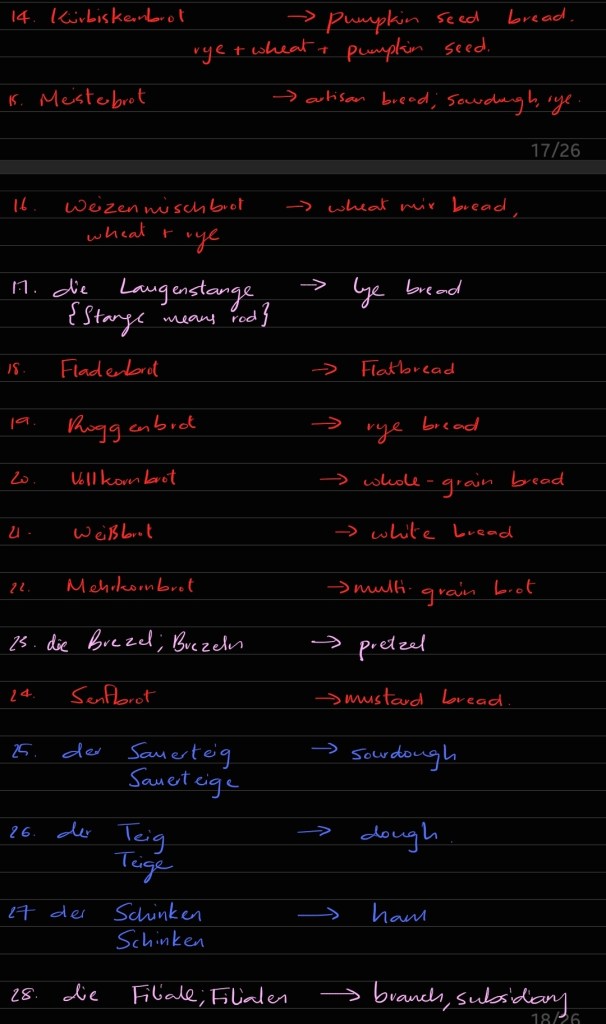
To quell the anxiety of having to move across the world (yet again), I have been learning German with a feverish earnestness. I have German textbooks targeted towards B1 intermediate speakers whose vocabulary I am trying to decipher and transcribe into my own head—and onto the Samsung Galaxy tablet I am bringing with me to Bremen in northern Germany. But no matter how many situationally specific vocabulary I memorise, no matter how many language podcasts I listen to, or how many grammatical rules I try to perfect, it will take several more years for words to flow out of my mouth with a natural rhythm.
However, I will persist.
I am terrified of the thought of walking into the Burgersamt, the office where I must go to register my address so that I can get a Tax ID with which I can open a bank account. I wonder what I will reply if the immigration official at the border asks me whether I want to talk in “Deutsch oder Englisch?”…”German or English?”. It will be my first interaction in mainland Europe that will usher in my time outside the Anglosphere. It will test the extent of my bravery, or perhaps not…I am not a coward for wanting to ease into a new country as much as possible, although given the speed at which I decided to make my move here, I am very much throwing myself into the midst of a cold Western European nation.
After my four years in the United States, I had made sense of a diluted European society, now I must prepare myself for the pure-blooded European society: the wannabe Aryans, the descendants of the Nazis, the peak of blonde blue-eyed societal ideals. Or at least, these are my preconceptions of a Germany that may or may not be like anything I imagine.
Interestingly, my German learning journey feels easier so far than my experience with French, precisely because of my previous experience learning French. The concept of gendered nouns did not seem so daunting this time even though German has 3 genders: the neutral in addition to the masculine and the feminine found in French and other European languages.
But what is daunting, is the case system. German has four grammatical cases: the nominative, the accusative, the dative, and the genitive. I do not know how to explain these concepts to someone who only speaks the English language. Luckily, I was bilingual since I developed my sense of self and my mother tongue, Malayalam, uses the case system to create and dissimulate meaning.
The English language is a prepositional language; it uses prepositions to convey the relationships between two nouns, or the subject and the object. Post-positional languages, like Malayalam, do not use prepositions, they instead change the ending of the nouns to indicate relationships. The only time English uses a similar linguistic method is to indicate possession. For example: “Sree’s book”. English adds an apostrophe s to the back of the noun, which in this case is my name, to indicate the book belongs to me. Malayalam changes or declines the ending of nouns to indicate all relationships between things. German has both features. It has some wacky prepositions and some declensions to convey grammatical meaning. Unlike Malayalam’s 7 or 8 cases, German only has 4 (thank god!) and Swiss German only has 3 cases. So Sree’s book would be “Srees Buch” in German; the apostrophe is removed, the transmutation of the word ending is more integral to the word, sans the addition of apostrophes and hyphens to mark a distinction from the added grammatical element.
German word order can also be quite complicated. Unlike English, or any other language I have come across, German loves to switch around its word order, especially after you use a conjunction and add on a subordinate clause. If you speak a sentence and include a related or contrasting sentence afterwards, you will likely be using two different word orders for both of them.
Plurals are also a headache. There are quite a few ways of forming plurals and I try to learn plurals alongside the meaning and genders of nouns. German words can also get very long. With a plethora of in-fixes, there are intriguing ways to combine words to create new words, although it can be scary to see words sometimes taking up half a sentence. Krankenversicherungskarte for example is a single word that means health insurance card. I love how Germans are unafraid of octasyllabic words.

Compared to German’s complex grammar and long words, French looks easier on paper. But to communicate in French is much harder, especially through the vocal medium. When a German person speaks a sentence with five words in it, one can understand that they spoke five words. Not something you could do with French without fine-tuning your listening skills. In French, the vowels and sounds between words elide and bleed into each other in ways that make it perplexing for language learners to decipher. German can be a mouthful, but does not suppress its consonants and can be understood more clearly than the muffled sounds of French.
No matter the grammatical complexities, everyday spoken language, in its admixture of slang and people’s individual modes of delivery, can be quite hard to learn no matter how much I gather from a book or audio packages.
After I learned to read and comprehend French text, it took me several years to be able to spontaneously deliver it in speech. I wonder if the same will apply to German. I can comprehend written German to an extent, but I have very little spoken experience in that language. I have no choice here to take a plunge.
And deep down, I think my attempts to learn and appear fluent in a foreign language is a reflection of my desire to appear fully human in a foreign country. I think it can be dehumanizing to not speak my host country’s language fluently as a migrant. There will be a cultural and perhaps a spiritual barrier that may prevent me from making real connexions with Germans which could lead to me ghettoizing myself. I will hardly posses the confidence I had when moving to the US because of my linguistic ineptitude. Hopefully, there will be people who appreciate my desire and ability to improve my knowledge of a language they have spoken since they were children.
However, if I am ever to achieve fluency in the languages I want to speak, I must move beyond the borders of the Anglosphere. I must put all of my linguistic knowledge into practice and dethrone them from the ether of my brain. The pure mental idea of a language must now get dirty. In one way or other, this will be a transformative experience. To dare to learn a new language is to dare to ask the world to listen to my voice and see me for my full capacity as a human being. To learn a new language is to dare to confront the unknown, to seek your place in the darkness. Perhaps, I am also asking to be loved, asking for kindness, in a world designed to keep us separate and divided. Moreover, I do wish to speak without the colonial intermediary that is the English language, it would be an act of love from my side as well.
All images shot on Olympus E-M10MarkIV by Sreekuttan “Sree” P S unless otherwise credited.
Read more of my work:

Fiction versus The Void
Fiction versus The Void Here I am again with my philosophy du jour. Human beings as a species require fiction in a plethora of forms to escape slipping into self-destructive nihilism. Varying forms of shared grand mythologies have been essential to…
Keep reading

The South of England in the Winter
The Jurassic Coast in the Winter: A Photo Journal The South of England felt eerie at first. The trees are shorter but are spookier than the ones I am used to in the US, their branches skeletal and long-nailed like a…
Keep reading

Beyond Conflict: Emily Dickinson and the Poetics of Desire
Beyond Conflict: Emily Dickinson and the Poetics of Desire Conflict is the engine of good writing; it creates tension and propels a story forward while retaining the interests of the reader. Or that is what is taught in creative writing classes…
Keep reading

 Escaping Samsara
Leave a comment