
Fighting like Waymond: Everything Everywhere All at Once, Buddhism and the Immigrant Experience
Contains spoilers.
The New York Times released a list of The 100 Best Movies of the 21st Century. While lists like this ignore most of world’s cinema outside of Hollywood and are only reflective of the world centred around the United States, the fact that a South Korean film like Parasite sits as the number one choice and Spirited Away, the Studio Ghibli magnum opus is on the top 10 indicates important cultural shifts in Western Hemisphere and the rising influence of Eastern art and philosophy on the English speaking world. They asked about 500 of their readers to vote for their favourite films and the results are subjective and includes few surprising choices.
But if I were the one making this list, I would put the 77th name of the list, Everything Everywhere All at Once on the 1st position—as much as I enjoyed Parasite. I would put Spirited Away second, but that is yet another topic.
The Daniels’ multiverse oeuvre is a tour de force that stretches the limits of human imagination and seeks to probe into some of our most essential philosophical questions ranging from identity, nihilism, and the nature of existence. The scope of the film is as vast and large as the name. Its visuals, story line, and characters are idiosyncratic and queer. The protagonist has hotdogs for fingers during parts of the film and the characters are rocks having a conversation for several exciting minutes of screen time! It is experimental as it is full of suspense. The 2 hours and 19 minutes long feature has something to offer all types of audiences even though, I left the theatre with a mild headache, in the daze of the multiplicity of the artistic exposé I had sat through. I had to watch it a second time and then a third time to derive more of its meanings and pleasure.
In the end, what blew me away was that at the heart of the film’s storytelling panache lies a perspicacious understanding of the immigrant experience and a cleverly modern reinterpretation of core Buddhist philosophical tenets.

Everything Everywhere All at Once has a uniquely Asian narrative style in its embracing of the chaotic, the Kung Fu, and the flamboyance. (I find this worth mentioning to emphasise that simply because all the characters in a film are Asian, the storytelling style and the gaze of the director may not necessarily do them justice). The film goes to great lengths to tell us that the protagonist, Evelyn (Michelle Yeoh won an Oscar for best actress for the role) is the most ordinary woman across all universes. Evelyn is doing the taxes for the laundromat she runs with her husband Waymond as the film begins, their life is as humdrum and monotonous as can be conceived. She is no Doctor Strange, so how does she end up navigating the matrices of multiverse travel?
Evelyn is chosen to be the perfect person to fight the dark force destroying all the universes because of her ordinariness. Only the most unimpressive Evelyn has the capability to become and channel the powers of all her selves from parallel universes to fight the evil that is challenging the survival of all of existence.
In a way, Evelyn get a chance that all migrants desire, to live all the lives we could have lived in all the places that we have moved through to get where we are. As she moves through all the parallel universes, she lives through all the Evelyns she could have been under all the different directions her actions could have taken her. What if she had not married Waymond and moved to the US? What if she had moved to a separate country of her own? What if she had pursued music or martial arts? As the film progresses, the universes become more bizarre and radically different from her current reality. In a certain universe, Evelyn in a lesbian with hotdogs for fingers, in another she is a rock.
But what connects them all is Evelyn’s sense of self, not a static and essentialist idea of the self, but a malleable one that transmutes itself as it moves through planes of existence.

One does not have to be an immigrant to relate to this experience. We have all had to choose diverging paths, leave people behind, move places and undergo changes that have had unexpected outcomes. We are a result of our varied choices and a cascade of the consequences of our actions. Perhaps, the scale of transformations is larger for migrants given the geographical and cultural differences involved but nevertheless, all of us contain multitudes.
Evelyn confronts the inevitability of change, the idea that all of existence is an endless ad circular sequence of transformations that has neither a beginning nor an end. After all, this idea is at the foundation of much of Indian and East Asian philosophy and spiritual thought. In Buddhism, the nature of existence is defined by trilakshana, the three indicators: impermanence, interdependence, and suffering (induced by the inherent imperfection of all things). Nothing is inherently meaningful or perfect. All things are undergoing changes that will render them unrecognizable in a matter of time and one must come to terms with it.
For some, such a philosophy and outlook might seem contrary to the spirit of life itself and impractical for the purposes of survival and happiness. Nietzsche calls it a form of “passive nihilism” even while deriving from the larger body of Buddhist philosophy for his own intellectual work.
But what lies at the heart of this philosophy is not the wisdom or the intellectual knowledge that the universe is impermanent, but the means of coming to terms with it through compassion and love. It is a matter of perspective like the symbolism of the googly eyes tells us throughout the film. One must look at the imperfect world through our third eye, a universal eye, the eyes of compassion.

Evelyn, like most of us, confronted with the trilakshana, the three indicators, almost falls into the pit of nihilism. She almost falls into the same trap that Jobu Tupaki (pocket gun in Telugu), the antagonist lands in, to enable the destruction of the universe and the self because there is no point to anything anyways.
But what saves her is Waymond, her husband, who chooses compassion and composure no matter the circumstance. It is a deliberate choice to see the world in a positive sense even as it falls apart around him. The impermanence of existence must fill you with compassion for all things, because we are on the same journey, everything from a raccoon seeking survival in the trash, to planets spinning in concentric circles, we are locked in an endless sequence of interdependent actions. The things we do can have far ranging influences and ripple throughout the universe. We can choose to make it easier for all of us to through the limits of existence together if we are compassionate enough to each other.
Evelyn opens her third eye when she learns to fight like Waymond. The cinematic shots of martial arts where Evelyn fights a long line of multiverse traversing combatants turn into an array of actions of love with which she conquers them. She gives each of her opponents something that indicates her compassion for them whether its a bouquet of flowers or a whip to the bottom (kinky).
In the terms of Vajrayana thinking, Waymond represents compassion, Jobu Tupaki wisdom (knowledge that the universe(s) are impermanent) and the film is Evelyn’s journey to bring wisdom and compassion together by opening her third eye.
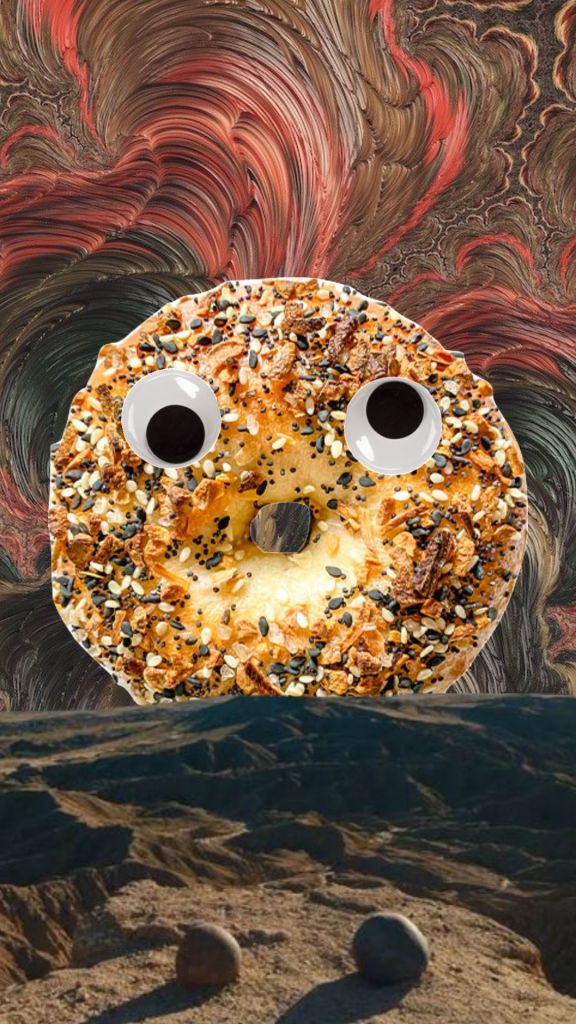
Through the course of the film, Evelyn learns to come to terms with the three indicators the compassionate way. She chooses life instead of the darkness of the bagel, the circle that consumes everything like a black hole; the impermanence and inherent meaninglessness of all things.
Evelyn is a migrant within all the possibilities of her own life. Ultimately, she comes to terms with the mutability of it all. No matter where she ends up, there will be imperfections that haunt her. As a famous singer, she would perhaps long for the stability of Waymond’s companionship. The impermanence of the universe will chase us everywhere.
As migrants, we are terribly aware of the potential for transformation inherent to everything. We are different people in different countries and different spaces, most of us have given up on the illusion of a static identity. We know that we are perceived differently in our chosen nations than our supposed homelands. The ideas of what it means to be home or to belong to a place transform themselves rapidly. We contain many identities that we bring with us.
Like Evelyn, we must become conscious of our power to make our own meaning and choose a compassionate path, a loving path to come to terms with the multitudes we contain. There is a potential to lead a fulfilling life no matter where we find ourselves, and may our actions benefit those around us in the process.

Now that you are here, also read:
Fiction versus The Void
Fiction versus The Void Here I am again with my philosophy du jour. Human beings as a species require fiction in a plethora of forms to escape slipping into self-destructive nihilism. Varying forms of shared grand mythologies have been essential to the growth and sustenance of civilizations since their inception. At a microcosmic level, a…


The South of England in the Winter
The Jurassic Coast in the Winter: A Photo Journal The South of England felt eerie at first. The trees are shorter but are spookier than the ones I am used to in the US, their branches skeletal and long-nailed like a witch’s wart-infested hands. The houses are smaller, made of brick, and retain an old-world…

Beyond Conflict: Emily Dickinson and the Poetics of Desire
Beyond Conflict: Emily Dickinson and the Poetics of Desire Conflict is the engine of good writing; it creates tension and propels a story forward while retaining the interests of the reader. Or that is what is taught in creative writing classes at a college level. I accepted this maxim without skepticism until I saw an…

 Escaping Samsara
Leave a comment