
The Secret of The Sand Grain
This time, I will tell you a story. A story that my grandmother told me when I was a child, and grandmothers all over India and its diaspora tell their grandchildren. I put my own spin on it. Forgive me, as I have grown, so have my understanding of tales of old.
Krishna, the avatar of the sustaining force of the Universe, was a mischievous child during his early days in Vrindavan. Krishna stole butter, played pranks on his compatriots, and had a gang of trusted friends who engaged in wild shenanigans across the village under his leadership.
One day, the boisterous lord was eating dirt in the yard. His brother, Balarama snitches on Krishna to their mother. Yashodha rushed to the yard to get hold of her son, to save him from the consequences of soil entering his digestive tracts.
“Child, is that dirt you are eating?” Yashodha says, stepping down into her yard. She gets hold of Krishna, who was seconds away from fleeing her grasp. “Is that dirt in your mouth?”
He shakes his head in denial.
“Why are you lying?”
He shakes his head again.
“Well then, open your mouth, let me see what is in there.”
And the story goes, the child opens his mouth, and Yashodha sees the entire cosmos in his mouth.
What does it mean to see a Universe in a child’s mouth? Is it a declaration of Krishna’s greatness? Is it a measure of Yashodha’s love?
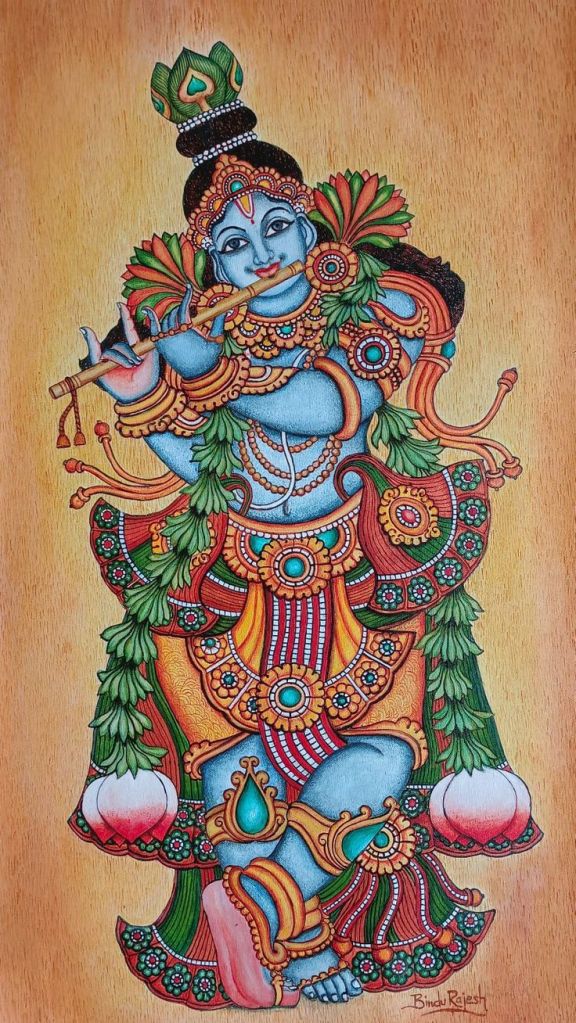
It could also be the grain of dirt revealing its secret through Krishna. The one that is the colour of the Universe may be a catalyst for Yashodha to see one of the smallest components of the world and building blocks of life in its true cosmic scale and significance.
Maybe, to love something is to see a self-contained Universe within it, to view it as ever-changing and containing multitudes. Even to love oneself and to understand oneself, we must be able to love and understand the world around us and the cosmos at large. We have no existence independent of everything else that is contained in the Universe. The smallest sand grain and gargantuan Black Holes light-years away have their roles to play in maintaining the fabric of existence. To see ourselves as separate from the rest of existence is an illusion that assumes and takes for granted the systems and civilizational institutions that seek to disconnect us from nature and thus from each other.
“To see the Universe in a sand grain,” as William Blake put it, is also a matter of empathy. It is a realization of interconnectedness and an acknowledgement of a common journey of everything on a living Earth. We share the journey of existence and transformation even with the inanimate. It is valuable even if we see ourselves reflected in them, as long as we can see the external Universe reflected in ourselves as well.

Sreekuttan P. S.
Writer, international student, and traveller from Southern India. I love well-spiced food and large books. Also a sucker for Buddhist monastic architecture and the film Everything, Everywhere, All At Once. I currently have 200 books in my dorm room. Hit me up if you have something to say. I am a great listener.
No AI was used in any part of my blog and blog creation process.


Leave a Reply